What Makes HDRP It Look Better URP?

Minh Khoa
Author
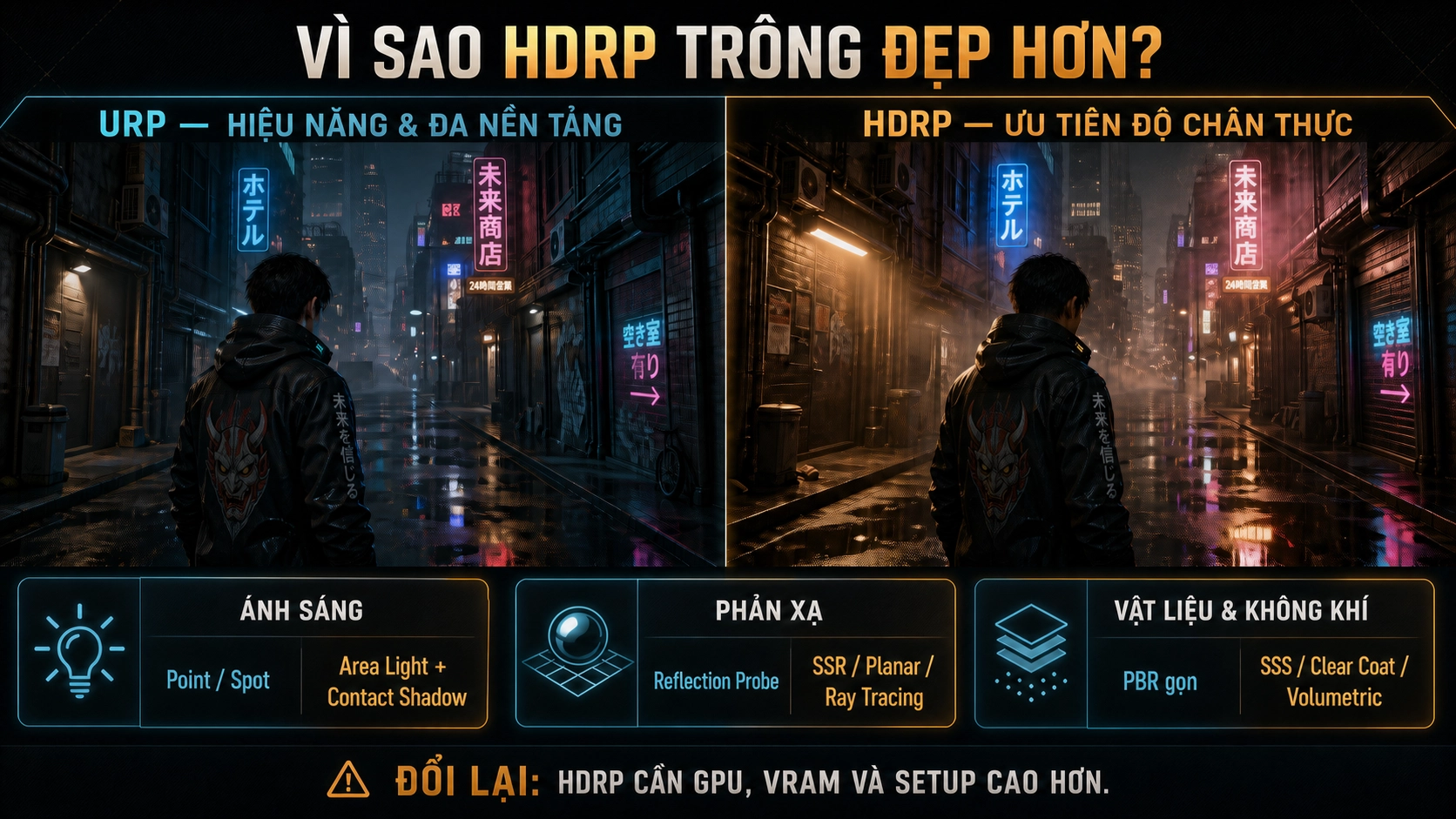 Không thể tải ảnh bên ngoài> Short answer: HDRP it does not magically make the model have more polygons or sharper textures. It raises the graphics ceiling by allocating more GPU to the data the human eye is very sensitive to: the size of the light source, bounce light, contact shadows, per-pixel reflections, how light passes through materials, and how it scatters in the air.
URP it deliberately simplifies or removes those calculations so a project can scale from mobile, Web, Switch, and VR up to PC/console. Look at the difference in the same scene: a rainy night alley with neon signs, a character, wet pavement, and fog.
This is a difference in visual ceiling, not a “3x prettier” button. Bad assets, wrong lighting, and weak art direction are still HDRP ugly. Conversely, a well-executed stylized game with URP can look far better than many games HDRP.
Don’t Blame Deferred Rendering for Everything
The explanation “URP use Forward, HDRP use Deferred and it looks better” is outdated. URP now has Forward, Forward+, Deferred both Deferred+. HDRP and it also uses both Forward and Deferred depending on the material type.
The render path mainly determines GPU how lighting cost is organized. What truly creates the gap are the algorithms HDRP running inside that pipeline.
1. Neon Lights Are No Longer Just a Bright Dot
In URPthe common realtime light sources are Point and Spot Light. They can make scenes look very good, but they are still compact light-source models.
HDRP has realtime Rectangle and Tube Area Light. That means a two-meter-wide neon sign can really be described as a two-meter-wide emitting surface.
Rectangle Light creates highlight streaks that match the shape of the neon sign and supports distance-based soft shadows; Tube Light is especially useful for long light sources. Light intensity uses lumen, candela, lux, or nit and goes along with the camera’s physical exposure.
URP still has Area Light for baking. You can also approximate it with emissive material, multiple Point Lights, or a custom shader. HDRP simply turns this workflow into a more synchronized and controllable realtime system.
2. Shadows and Bounce Light Make Objects “Belong” to the World
Shadow maps often miss the gap under a table leg or where a shoe touches the road surface. HDRP uses Contact Shadow to fill in contact details in screen space; Micro Shadow uses ambient occlusion to simulate self-occlusion at very small surface scales. PCSS filtering and Ray-traced Shadow can handle more advanced soft shadows. Just a few correctly placed dark pixels are enough to make a character feel less like it is floating.
Bounce light is important too. Place a white sphere next to a red wall: the light must hit the wall and then bounce red light back onto the sphere. URP looks very good with baked GI and Adaptive Probe Volumes when the scene is mostly static. HDRP has SSGI that reacts in realtime to data visible on screen; RTGI sees more, but depends on hardware and is very expensive.
Not every game HDRP turns on ray tracing. Contact shadow and SSGI in the right places already make a clear difference.
3. Puddles Reflect the Thing Standing in Front of Them
URP by default mainly relies on Reflection Probe. You can think of a probe as a panorama photo captured around a position and then applied to every nearby reflective surface.
It is cheap, but a character walking past may not appear; mirrors or flat floors also easily reveal the wrong viewpoint.
HDRP has several layers of reflection built in:
SSR          → lấy vật đang thấy trên màn hình
Planar Probe → phản xạ đúng góc cho gương, sàn và mặt nước phẳng
Probe / Sky  → lấp dữ liệu còn thiếu
Ray Tracing  → có thể thấy cả vật nằm ngoài màn hình
SSR objects disappear when they leave the camera; ray tracing is very expensive. The strength of HDRP is multiple techniques know how to fall back to one another. Thanks to that, people, neon signs, and shopfronts reflect on the road surface as if they coexist in the same space.
4. Skin, Hair, Fabric, and Car Paint No Longer Reflect Like the Same Kind of Plastic
's material system has URP normal, occlusion, and clear coat in Complex Lit—enough for most games. metallic/speculargoes further with specialized material models:
HDRP Subsurface Scattering and Transmission:
- light enters skin or leaves and scatters before exiting. That is why a person’s ear can turn red when lit from behind. Anisotropy:
- the highlight stretches along the direction of hair strands, velvet, or scratched metal. Iridescence:
- the color changes with the viewing angle, like soap bubbles or insect wings. Hair, Eye, Fabric, and
- separate models for hair, eyes, fabric, and layered materials such as car paint. StackLit: A 4K texture only describes surface detail. The material model determines
how light reacts to that surface **. This is why increasing texture resolution cannot replace SSS on skin or anisotropy on hair.**5. In
, Air Is Also Part of Lighting HDRPSimple fog often just looks like a color layer that increases with distance.
Volumetric Fog in
approximates the space in front of the camera with a 3D grid to calculate fog density and the amount of light absorbed or scattered. HDRP As a result, headlights can form beams of light; when volumetric shadow is enabled, a trash can can cut through that beam; a local volume can also make an alley corner thicker with fog than the main road. Physically Based Sky, volumetric clouds, and exposure continue to make the sky, fog, and camera respond consistently to one another.
In return,
it must update 3D textures, take many samples, and use data from previous frames to reduce noise. HDRP Why
Not Turn All of This On? URP Because every “better-looking” layer comes at a cost:
and SSGI SSR across many pixels; volumetric effects need a 3D buffer and temporal history; specialized materials create more complex shaders; ray tracing needs an acceleration structure, denoiser, and many ray-march . VRAMWith VR, most of the work still has to be done for both eyes.
HDRP it may be assumed that the machine has GPU modern and compute shaders. URP must run on both tile-based GPU mobile, standalone VR and Web.
HDRP buy fidelity with GPU budget. URP buy scalability by reducing or simplifying expensive calculations.
Choose Realism
| Project | Should choose | Reason |
|---|---|---|
| Mobile, Web, Quest, Switch, stylized game | URP | Broad platform support, easy to control frame time |
| PC/console realistic, many dynamic lights, wet floors, da/tbaked, volumetric | HDRP | The features high-end have been integrated into a single system |
| Indie PC only needs a few nice effects | Usually still is URP | Avoid adding unnecessary configuration complexity, shader complexity, and baseline cost |
| Automotive, archviz, cinematic | HDRP | Materials, camera, reflection, and physically based lighting matter more than platform reach |
Built-in Render Pipeline is not an “in-between” choice. It is the pipeline general-purpose old; Unity began deprecating it from 6.5 and does not recommend it for new projects.
An important note as of 2026: Unity has announced plans to bring physical light units, auto exposure, physical sky, realtime GI and SSR to URP; this is not yet a fully available feature set in URP 6.3. HDRP shift focus to maintenance and stability. The gap will narrow, but the selection principle remains unchanged.
How to Remember
URP  = tính vừa đủ để chạy được trên nhiều loại máy
HDRP = giữ thêm dữ liệu và chạy thêm pass để ánh sáng đáng tin hơn
The key sentence: HDRP looks more realistic not because of a “secret shader.” It looks better because the whole chain of light → shadow → reflection → material → atmosphere has more information and supports one another. Only choose HDRP when the game’s visuals truly depend on that chain; do not choose it just because the name contains “High Definition”.